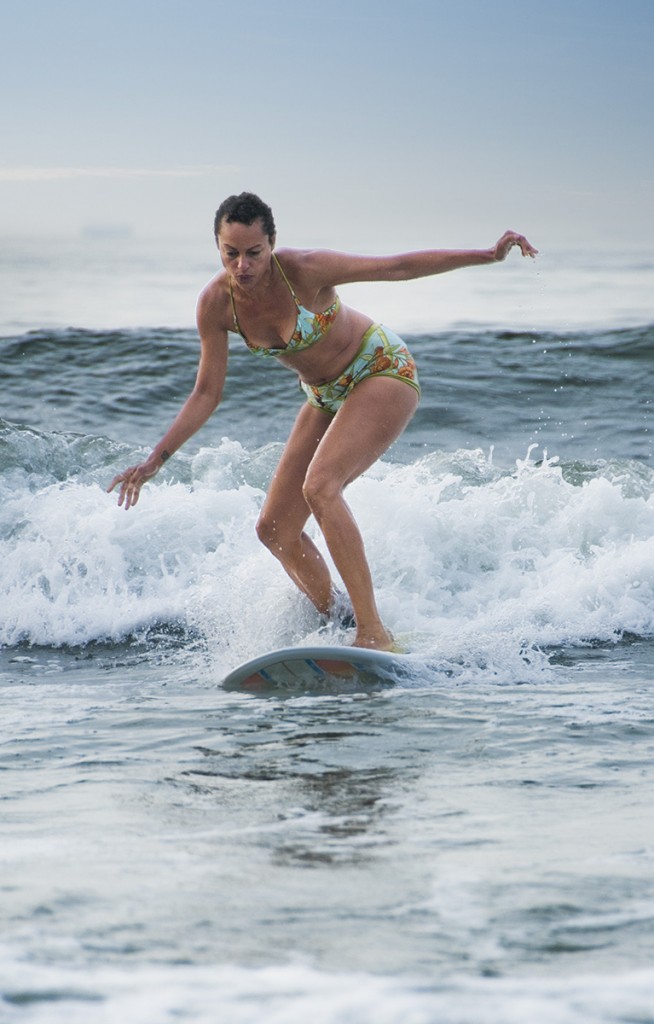
Diane surfing the 90th street break in Rockaway, Queens, New York City photo by Josh Gosfield
Sometimes our job determines our lifestyle. What happens if it’s the other way around? That’s what Diane Cardwell wondered. Early 40’s, just post-divorce, Diane was on assignment for The New York Times covering a story on the influx of chic hotels gentrifying Montauk, an old fishing village on the eastern tip of Long Island. There, Diane had what she calls her Eureka Moment.
“I’m reframing the negative, thinking to myself, ‘In 10 years this will all be a memory.” Illustration/Josh Gosfield
Go back to early 2020.
If you had known your world would be turned upside down and that you’d be locked in your home, that you’d possibly lose your job or be forced to work a job that might make you sick, that you’d be kept away from family and friends, told to wear a mask, and become fearful for the lives of your loved ones, you might have assumed you’d lose it.
But guess what? You probably didn’t. You may have even surprised yourself with how well you adapted to a world gone mad.
We’re not just making this up. This is based on a survey we conducted to find out how people responded, reacted, and adapted to life in a pandemic, posing such questions as what’s been hardest for you, what’s given you the most pleasure, and what have been your coping strategies. We called the survey “A Portrait of This Moment,” and sent it to a diverse group of hundreds of people from age 18 to 85, in a wide variety of socioeconomic circumstances, people who’ve been fired or furloughed, essential workers, people working from home, and students from high school to higher ed managing remote learning. We created this survey not only to gather information, but to offer people an opportunity to reflect upon their experiences. (If you’d like to take the survey yourself, here’s a link.)
When we created this survey, we expected to hear a lot about people’s pain, frustration, and anxiety. Obviously many people have worried about their health, jobs, and finances, their education or their children’s education, as has been documented in preliminary findings of a Census Bureau survey. But what surprised us most about the results was the spirit of positivity expressed by so many people.
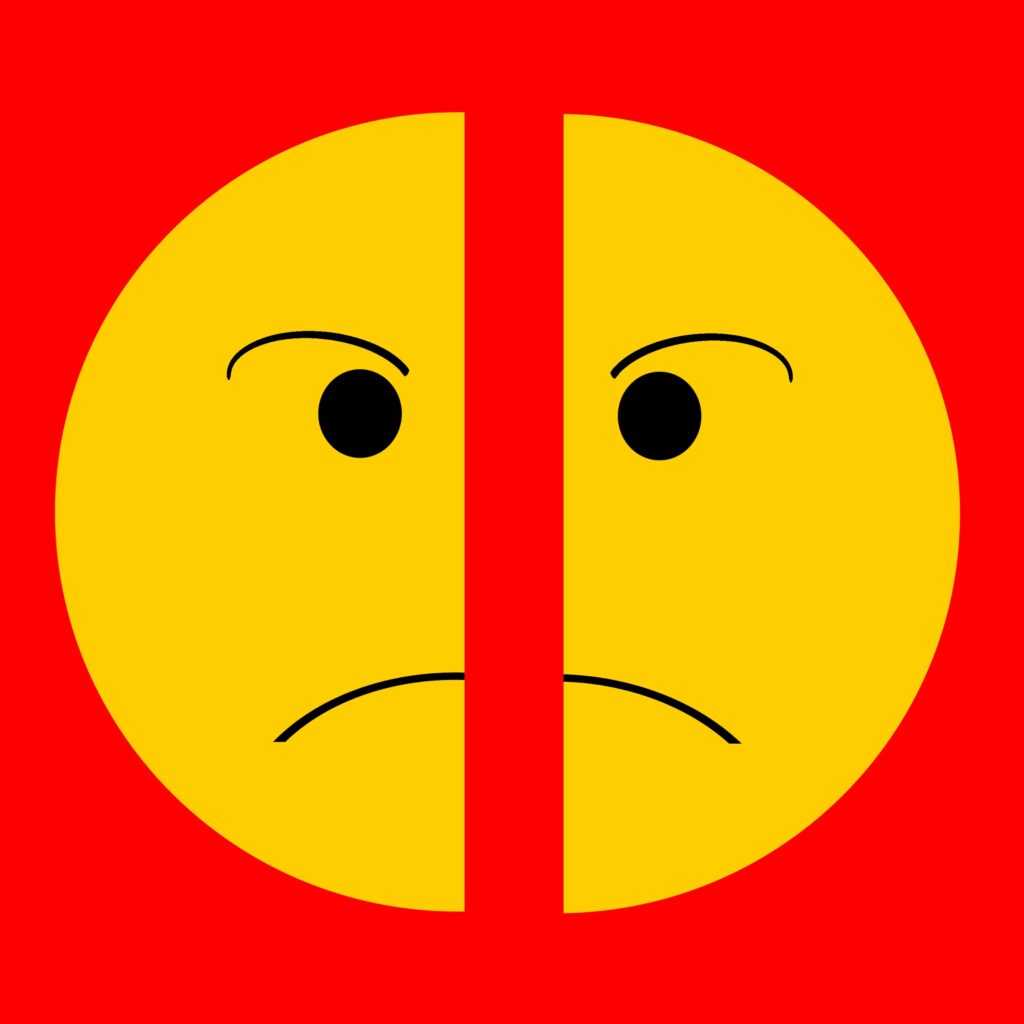
“What makes a dilemma so dilemma-ish is that only one of these two actions can be fully implemented.” Illustration/ Josh Gosfield
The lockdown versus the open-up-the-economy battle is inescapable. It’s being played out in the media, White House press briefings, halls of Congress, statehouses, Facebook and Twitter. The question is which side are you on?
If you’re a salaried, progressive-minded NYC health care worker with a mother in a nursing home, you’re probably a lockdowner, wanting to keep America shutdown till someone invents a vaccine.
But if you’re a Nebraskan owner of a small town diner and a parent to three sports-loving teens who think remote learning is a joke, you’re probably an open-upper, wanting to restart your business and send your kids back to school and sports leagues.
The first step in solving a problem is to define what type of problem it is. The lockdown versus opening-up problem is a classic moral dilemma. The paragon of moral dilemmas is Sophie’s choice. Sent to a concentration camp, Sophie’s confronted by a Nazi official who tells her she can save one—and only one—of her children, her son or her daughter. What’s more, it’s Sophie’s choice to make.
Moral dilemmas such as Sophie’s choice, or the lockdown versus opening-up-America choice, confound us because they scramble our sense of right and wrong. It’s no wonder so many of us are confused. To get a clearer picture of how to think about this problem, let’s break down the three aspects of a moral dilemma.
1. Two good results: A dilemma begins with two good results. Just as Sophie wants to save both her son and her daughter, we want to save lives in a pandemic and we want to return to normal life, sending students back to school and adults back to their jobs.
2. Two separate actions: In a moral dilemma, either of the two good results can be achieved. But only with two opposing actions. Sophie can say, “Save my son.” Or she can say, “Save my daughter.” We can stick with the lockdown option. Or we can choose to open up businesses and schools.article continues after advertisement
3. Each action cancels out the good results of the other action: Just as Sophie can’t choose to save her son and her daughter, we can’t open up the economy and enforce a lockdown at the same time. That’s why a moral dilemma takes a hatchet to your sense of right and wrong. Although the two actions are designed to do good, they cancel out the good results of the opposite action. The lockdown throws people out of work, destroys businesses and ruins education for many. Opening up spreads disease, causes death, and perhaps even sets off a new round of lockdowns.
What about it, Sophie? Your son or your daughter?
What about it, America? The elderly, the sickly, the essential workers, and the city-dwelling minority, or the economically damaged majority?
To make the morally correct choice, it seems that both actions are required. But then again both actions are forbidden. Damned if you do, damned if you don’t.
There’s an even more insidious wrinkle that makes our pandemic dilemma so tricky to solve. There’s no way to be certain about the consequences of either action. Opening up the economy speeds job and education recovery, but what about the spread of disease? There are many models and those models will get better as more hard data is collected, but those models are partially based on assumptions. Since the crafters of each model make their own assumptions, the models often predict different outcomes. Of course, there’s good reason to heed a model that suggests caution. But in the end, we can’t know for sure what will happen to the spread of disease if we open up or to the health of the economy if we stay in lockdown.
When you add the unknown consequences of an action to a moral dilemma, it’s as if you’re Sophie making her choice at the craps table in a casino.
It gets even worse. In the study of moral psychology, experimental results show that people tend to embrace facts that support their moral choices. Why? People want to avoid the guilt they’d feel if their choice causes suffering. That’s why the NYC progressive embraces the most drastic spread-of-disease predictions and downplays the needs of people to return to their jobs. And that’s why the small town business person in an area with few COVID-19 cases searches for news that proves the disease isn’t so deadly, perhaps even that it’s a hoax. It’s a battle of choices fought with chosen facts that may send our country careening toward an exhausting post-pandemic blame game. It would be tragic, if, as a country we ended as damaged as Sophie, who after losing both her daughter, and very likely her son, turned to alcohol and an abusive lover, and eventually took her own life. article continues after advertisement
Perhaps solving this dilemma seems hopeless. But it isn’t. First of all, our choice isn’t as binary as Sophie’s. We can choose some of both. As localities open up, step-by-step, remaining partially shut, yet partially open, we’ll move past theoretical models to see how the economy responds and how quickly the disease spreads. There will be trial and error. As communities experiment with hybrid open-shut tactics, other communities can copy strategies that work, and avoid tactics that fail.
But getting through this pandemic without paying a Sophie-like price to our national psyche will require more than that. It will require a new mindset that embraces ambiguity.
This new mindset will require us to adopt a clear-eyed, unsentimental style of reasoning that we, as idealistic Americans who always want to command the moral high ground, can find very troubling. To get through this pandemic, we must admit that we will have to sacrifice, to a certain degree, one good for another. We have to accept that we can’t save the life of every vulnerable person or save every job, business, and student opportunity.
We have to accept that whatever we choose to do will be partially right and partially wrong. No matter what we decide our hands will be dirty because someone, somewhere will suffer or die. But if we respect the suffering of others, and do our best to make rational decisions based on imperfect data, we can get through this pandemic with our national soul intact.
Follow us on Instagram @Find.Your.Road_for more Stories & Strategies on People & Work. To find out more about what we do, please visit us at SweeneyGosfield.com.
Our story “Sophie’s Choice” first appeared in Psychology Today. You can check out more of our stories in Psychology Todayhere.
Follow us on Instagram @Find.Your.Road_for more Stories & Strategies on People & Work. To find out more about what we do, please visit us at SweeneyGosfield.com.
We’ve all celebrated the healthcare workers on the frontlines. They’re featured on the nightly news, cheered for by tens of thousands every night at 7pm in New York City, and lovingly drawn, painted, and photographed by artists around the world.
But do we really know what it’s like to be one?
When an ER nurse on the night shift in a busy hospital in Queens, New York, that was practically overwhelmed with Covid-19 patients, told us she had a message for everyone, we wanted to hear what she had to say.
This is a nurse who prefers anonymity. “I don’t go into a lot of details about my job with my friends on the phone,” she told us. “I don’t post on social media.” She hasn’t even had a chance to bask in the glory of a single 7PM healthcare worker gratitude shout-out. “I work the night shift,” she said. “I’m on duty when all that goes on.”
In the emergency room, she’s seen it all. The lack of testing. The lack of protective equipment. The lack of a coordinated government response that left healthcare workers exposed. The constant stream of feverish, frightened people coming in. People dying in ambulances before they reached the hospital. People dying in hallways. People dying without loved ones. “I’ve had to tell a son or daughter, ‘You need to leave your 80-year old mother with me. I know she doesn’t speak English. I know she can’t breathe. But you need to leave.’ And I’ve had to do that, over and over again,” she told us.
Despite the harrowing things she’s seen, the risk she faces every shift, and the emotional toll of her work, this nurse is resolute. “It’s my job,” she says. “We all keep showing up. That’s who we nurses are.”
And what’s this nurse’s message to us?
Number 1. Be a hero.
“If you’re social distancing right now, you’re a hero. Seriously. You’re doing your part to prevent yourself, or maybe someone else, from ending up in an emergency room like ours. So continue practicing that.”
Number 2. Stay informed.
“There is good information out there being disseminated by medically credible sources. Figure out who they are, and listen to them, so you can make decisions wisely about your own activities and health.”
Number 3. Be kind.
“Be kind to everyone. You don’t know their story. I am seeing a lot of beautiful things, displays of generosity and gratitude during this time, nurses showing up from around the country, people taking their time to make masks for us. I am also seeing a lot of terrible things. Racism. Intolerance. We don’t know what the second or third or fourth wave of this pandemic will look like. But we do know that we are all human, interrelated. The crisis is a human problem, and to solve it, we have to stick together. I do my part, I’m asking everyone else, you do yours.”
Follow us on Instagram @Find.Your.Road_for more Stories & Strategies on People & Work.
You may hope that your employer won’t be forced to lay you off. Or you may hope that the big project that you were in the middle of—the film that was about to go into pre-production, the product that your client was about to launch, the first year at college that you were looking forward to—happens. Or you may hope that you can sit down with all your loved ones to share a meal.
The problem is by Day Whatever, you may be starting to wonder if hope will do you any good.
But, in times like these, hope is exactly what we need.
Thirty-one years ago, a playwright in Prague, easily could have lost hope. He fought the power of communism in his country, and was imprisoned on and off for two decades because of his actions. The playwright, whose goal was to bring democracy to Czechoslovakia, had a lot of time in his jail cell to think about the concept of hope.
“Hope is not the same as optimism,” he wrote. Hope “is not the conviction that something will turn out well, but the certainty that something makes sense regardless of how it turns out.”
In other words, the playwright was certain that democracy in his country made sense, and he was still hopeful about it regardless of whether or not he could make it happen.
But hope can be hard, because hope requires something from us. Hope is not passive. Hope requires us to act. With each small act we muster—acts that make sense to usregardless of their outcome—hope draws us on. And as it draws us on we come to realize that hope is a renewable resource that replenishes itself with our small steps of progress.
The playwright Vaclav Havel saw hope everywhere. Hope was the Czech dissidents copying underground newspapers and passing them around. Hope was the Czech students assembling to march again and again in protest of a government they did not support. Hope was the hundreds and thousands of ordinary citizens making their way to the center of Prague to stand in the crisp Fall air in the square in 1989, jingling their keys to make noise as they chanted for their freedom.
Havel, who went on to become the country’s president after the bloodless revolution that overturned communism, wrote, “It is hope, above all, which gives us the strength to live and continually try new things.”
At this moment, our hope is being tested. Yet it is in troubled times such as these when we need hope the most. The choice is ours. We can choose to remain in a wishful state, passively hoping that things will return to normal without taking action. Or we can pay lip service to hope, only to snicker cynically behind its back to ward off disappointment. Or we can draw on hope, and its endless supply of energy, to hope something into existence. Something for ourselves, our families, our communities. Something that we take small steps toward each day not because we’re sure of its success, but because we’re in pursuit of something that makes sense to us to do regardless of how it turns out.
Ask yourself, What am I hoping for? and What actions can I take to make it happen? You may be surprised to find yourself, like the playwright Vaclav Havel, reinventing your place in the world.
Follow us on Instagram @Find.Your.Road_for more Stories & Strategies on People & Work. Find us at SweeneyGosfield.com. Our story “Hope is Not a Wimp” appeared first in Psychology Today, you can check out our other stories in Psychology Todayhere.
Alone in our homes, staring into space. Fauci on TV again. Forgetting what day it is. Another Netflix marathon. A squabble with a loved one. Awake at 3 a.m.
We may not realize it, but a lot of what we’re feeling now is about loss. Loss of freedom to go where we want to go. Loss of connection with friends. Loss of milestones—vacations, graduations, weddings. Loss of career momentum. Loss of a job.
“This is what someone goes through after a loved one dies,” says Debby Derman, a grief counselor based in Pennsylvania. “We haven’t experienced this kind of collective grief since 9/11. That was a community in mourning,” says Derman, who worked with firefighters’ widows in Staten Island in the aftermath of the event. “Now we are a world in mourning.”
Grief, from the Latin gravare to “make heavy,” referred to the burdening of someone with a weighty object. It wasn’t until the 13th century that the French began to use the term, grief, to describe the heaviness we feel inside of us as a result of loss.
Derman was working as a children’s behavioral specialist when two traumatic events altered the trajectory of her life and her idea of what she was meant to do. When she was 35, both of her parents died in a plane crash. Just four years later, her husband, father to their two toddlers and a baby on the way, dropped dead of a heart attack playing rugby.
Derman joined a widow’s support group and became fascinated with the human capacity for resilience. She went back to school for a doctoral degree so that she could counsel others suffering through loss. She’s been practicing as a grief counselor for 20 years.
Derman shares with us three strategies we can all use to move through loss.
1.Never Compare Your Grief to Someone Else’s
Maybe you’ve lost your financial security. Maybe you’ve lost a job or career you’ve been working at your whole life. Maybe you’ve lost someone to illness. “We all have our losses. And your loss is your loss,” says Derman.
There is no gain, whatever it is, in comparing it to someone else’s. “That’s a trap,” Derman says. “The most important thing I’ve seen as a grief counselor is to never ever ever compare your grief to someone else’s. If you try to compare your loss to someone else’s, thinking, ‘I have it worse than you do,’ then you’re going to become very isolated and no one is going to want to confide in you. It’s not a contest. Everyone needs to be compassionate with one another. Giving and receiving compassion is an important part of healing. And the best way to do this, is first, don’t compare.”
2.Sit Still
“Know when to turn off the TV or the radio or to stop scrolling through your Twitter feed. Too much external noise will keep you from processing your own thoughts and feelings,” Derman advises. “Instead sit still. When I worked with the firefighter widows, we asked them to keep a journal for three reasons. To clarify their thoughts. To see where they’d started. And to see how far they’d come. When we don’t give ourselves the space to turn down the noise, and don’t sit with our own thoughts, we cannot prioritize our goals and acknowledge our progress. Writing down a line or two or more of how you’re doing or what you’re thinking can be an enormous help to figure out how to proceed.”
3.Look Forward to a Time When This Will Be Your Past
“When I was taking care of two kids, and pregnant with our third child, and my husband died, I was devastated,” Derman told us. “I did not think I could make it through the week, even the day. Then my sister told me something that put it all in perspective. She said, ‘One day this will be your past.’
In the middle of trauma, deep mourning, or the type of loss many of us are experiencing in this crisis, you really can’t see that you’ll ever be out of it. You have to remind yourself, things will get better. Will things be different when this is over? Yes. Will you be different when this is over? Very likely.
But to get there you have to take small steps every day. If a day’s too long, try a morning. Then the afternoon. After my husband’s death, I would negotiate an hour at a time. I’d tell myself, ‘It’s 10 o’clock, just let me live until 11.’ Then it was two hours. Then three. Then it was a day, a week. It’s okay, even energizing, not to dwell all the time on the losses. Because you just can’t. By looking forward to a time when this will be your past, you’re building up what we all need, hope. That’s what we humans thrive on, hope.”
Three entrepreneurs tell us their secret to winning in a crisis. Josh Gosfield/Illustration
In January 2020, Micheal Kirban, CEO of Vita Coco, saw his company’s global profits soar. As customers stockpiled his coconut water, sales tripled. It’s a dream any entrepreneur hopes for. “My business is on fire,” says Kirban.
As shutdowns spread across the U.S., Kirban’s salespeople were posting and boasting on social media about their sales. “On the one hand, I’m thinking, ‘This is great,'” Kirban told us. “On the other hand, I’m thinking about the restaurant, hospitality, and retail workers, who live paycheck to paycheck, now they aren’t getting paid.”
In good times, winning for an entrepreneur is straight-forward: Having the most popular product, gaining market share, or seeing a spike in profits. But in the midst of the global pandemic, what does it mean to win?
Kirban, whose entrepreneur father always taught him to be responsible for others, felt he had to do something. Although Vita Coco is a small business, Kirban wanted to use his profits to make a large donation—a million dollars. “My CFO didn’t love the idea,” admits Kirban. “Neither did my 7-year-old son or 9-year-old daughter. They said, ‘Daddy, that’s a lot of money to give away!’ But I knew we had to dig deep on this.”
When Kirban sent out an email to his 300 employees to share the news about the company’s $1 million donation to feed hungry families, he got back more emails than ever before. “It was overwhelming,” he said. “People wrote to say how moved and how proud they were. One said, ‘Oh my God, I’m in a carpet store now, and I’ve got to wipe the tears from my eyes.'”
For Kirban and his employees, winning the bottom line in the middle of a pandemic didn’t feel like winning. But using profits to help people in need did.
“What we’re seeing now in this pandemic are examples of a natural, spontaneous human response that I call ‘unconditional altruism,'” says Athena Aktipis, a psychology professor and co-director of the Human Generosity Project. Aktipis defines unconditional altruism as a spontaneous act of generosity, such as Kirban’s, when the giver is not expecting to be paid back. This response of reaching out to help people in need is most common during a crisis—Black Swan events, such as earthquakes, floods, and pandemics.
Andrew Le, the founder of Buoy Health, is also a winner in the pandemic. Buoy Health offers a digital health screener, which sorts through a database of thousands of symptoms to help a consumer detect the likelihood of having a medical condition. The screener helps the user understand their level of risk for a particular condition and connects them to the right health care provider.
Buoy Health was in the right place at the right time. Well before the pandemic hit the U.S., Le realized how fast and deadly the spread of COVID-19 could be. While others ignored the coming crisis, Le jumped into action. He led his team of engineers on an 11-day, moonshot quest to collect COVID-19 data from around the globe and build a COVID-19 feature into their digital screener. Once the feature was built, Le spread the word. His home state of Massachusetts, with 6.8 million residents, asked Le to customize the feature for its Mass.gov website, a partnership that would double Buoy’s user base.
Although it was a boon to their bottom line, Le and his team felt something much more personal and profound than a business victory. Racing against time, clocking 20-hour workdays to customize their COVID-19 screener, they were motivated not so much by gaining market share, but by providing medical advice to fearful people, and saving lives. After the job was done, Le held an emotional company-wide meeting. “I was bawling,” he said. “And I wasn’t the only one.”
Doing good feels good. And doing good gave the Buoy Health employees something that profits could not buy—the gratifying sense that they weren’t spectators in a pandemic, but agents of change whose work was helping people in need, even saving lives.
When the institutions we depend on can’t take care of us, then who can? It’s often those who’ve escaped suffering and have the time, money, or resources to channel into helping those in need. Aktipis explains that societies rich with people like Kirban, Le, and their employees have an advantage over societies that aren’t. Although we’re taught about the survival of the fittest, Aktipis has found in her research of societies such as the Maasai herders in Kenya and American cattle ranchers along the Mexican border that the practice of unconditional altruism not only keeps a society stable; it increases their long-term chances of survival. It’s an unwritten code: When you’re in trouble, and I have the resources, I’ll help you, and down the road, when I’m in trouble, and you have the resources, hopefully, you’ll help me.
And what about the toilet paper maker? For Juan Corzo Jr., who co-runs Miami-based family business South Florida Tissue Paper Co., business is booming—sales are up 550 percent. “Sure, it feels good to be doing well,” Corzo told us. “But it’s also sad to see the four hundred people from the hospitality and restaurant industries who show up every day at our factory looking for work. I’ve been able to hire about 18 laid-off workers. And I’d love to hire more. But it’ll take us at least 8 weeks to expand productions.”
Of course, Corzo could jack up his prices as other paper product profiteers have. But for Corzo, success is not about cold, hard cash. He hasn’t raised his prices a penny. “Our product isn’t a want thing; it’s a need thing,” Corzo said. “Success to me is being able to fulfill this need for our community as best we can. I’m humbled to be able to provide it. Next time it may be us needing something we don’t have.”